"Finding a reliable service in Grey Bruce was tough until I found Bats and Wildlife. The work was immaculate, and the lifetime warranty gives me total peace of mind. Worth every cent for a bat-free home."
Sarah M., Meaford
Licensed · Humane · Lifetime Warranty
Humane exclusion across Grey Bruce Simcoe & Huron — same-week service. Bats are protected by Ontario law. We handle removal the right way, the first time.
Free quote · no obligation
Just your name, phone, and a sentence about what you're seeing — that's enough for us to schedule an inspection. Most homeowners get a quote within 3-5 business days, with same-week scheduling possible across Grey Bruce Simcoe & Huron.
Four core services covering everything from initial inspection to attic decontamination.
The only legal method for removing bats in Ontario — humane one-way exclusion with a lifetime warranty.
Learn more →
Comprehensive home sealing so bats never come back. Lifetime warranty against re-entry.
Learn more →
Safe removal of bat guano and contaminated insulation by trained specialists in full PPE.
Learn more →
Raccoons, squirrels, skunks, and other wildlife — same humane-exclusion approach we use for bats.
Learn more →
Free on-site inspection. We identify every entry point — bats can fit through a 1cm gap.
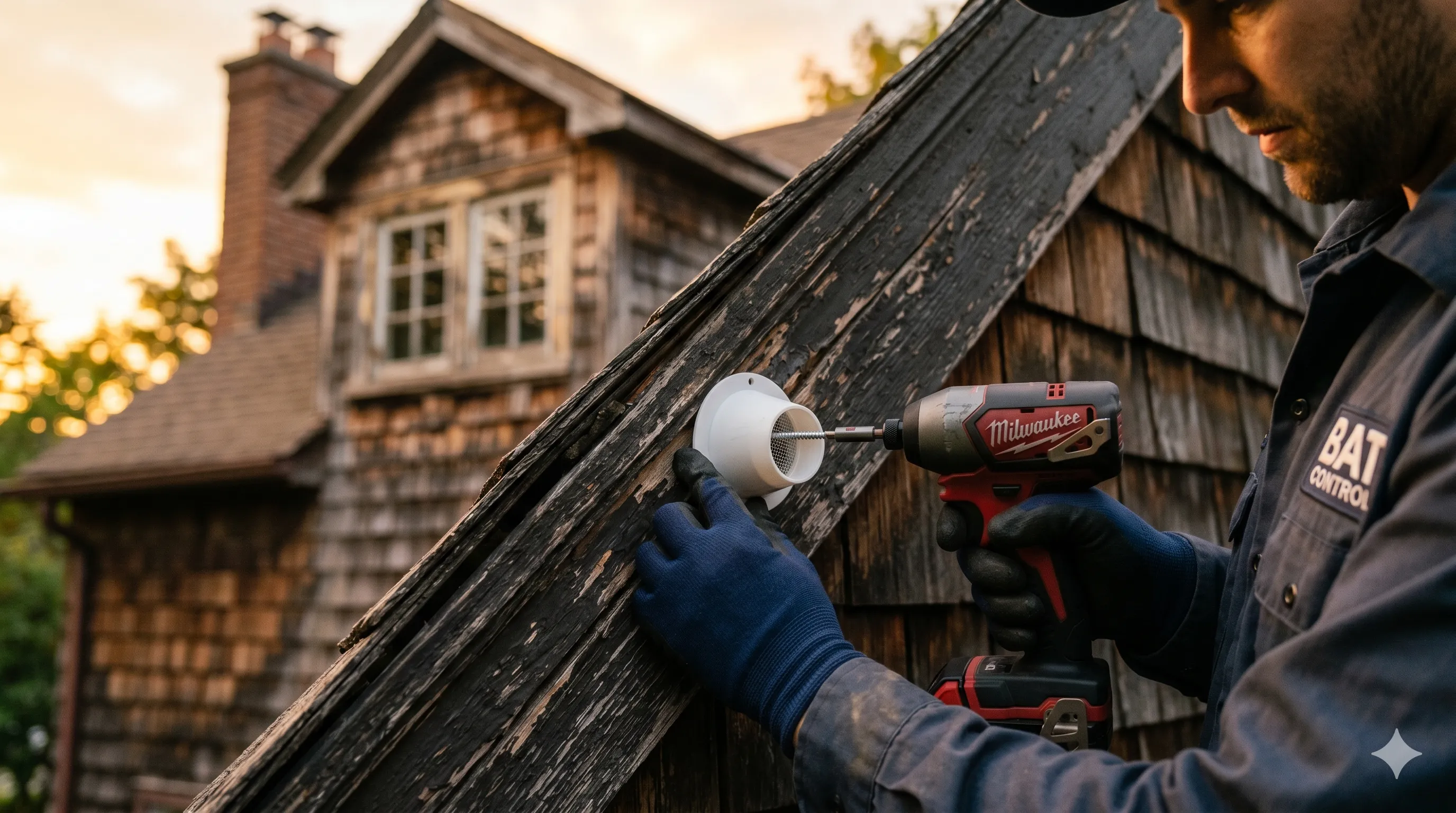
One-way valves let bats leave but never return. No bats are harmed. Compliant with Ontario law.
Every entry point sealed with permanent materials. Lifetime warranty against bat re-entry.
Ontario regulations
Bats in Ontario are protected wildlife under two provincial statutes. The Fish and Wildlife Conservation Act covers all bat species — penalties for harming, capturing, or relocating bats reach $25,000 per offence for individuals. The Endangered Species Act adds another layer of protection for the little brown bat, the species most often found in residential attics.
The practical effect: lethal control, trap-and-relocate, fumigation, and "DIY removal" are all illegal in Ontario for bats. Humane exclusion — letting bats leave on their own through one-way valves, then permanently sealing every entry point — is the only method that's both legal AND effective long-term.
We never do exclusion during Ontario's bat maternity season (May through early August), full stop. During that window, flightless pups inside the colony cannot leave through one-way valves and would be trapped to starve. Provincial law and our own ethics both prohibit it. If you call during maternity season, we inspect, prepare a plan, and schedule the actual exclusion for the moment the season ends — typically mid-to-late August.
Compare your options
Every Ontario homeowner with bats faces the same three choices. Here's how they actually compare on legality, effectiveness, and cost — based on what we see across hundreds of homes and thousands of entry points.
What we do
What others do
What homeowners try
For the full case on humane exclusion vs. traditional methods, see our explainer on bat exclusion vs. bat removal, or the four practical reasons in our complete guide.
Service area
Based in Owen Sound, we cover Grey, Bruce, Simcoe, and Huron Counties — the entire stretch from Tobermory at the tip of the Bruce Peninsula down to Hensall in South Huron and east to Innisfil on Lake Simcoe.
Real reviews from homeowners across Grey Bruce Simcoe & Huron.
"Finding a reliable service in Grey Bruce was tough until I found Bats and Wildlife. The work was immaculate, and the lifetime warranty gives me total peace of mind. Worth every cent for a bat-free home."
Sarah M., Meaford
"After getting high quotes from larger removal companies, I found Bats and Wildlife. They were much more affordable and offered a better warranty. They are now my go-to for any wildlife issues in Grey Bruce."
David L., Owen Sound
"We've had issues for years, but Bats and Wildlife did a fantastic job sealing all potential entry points. They went above and beyond what was expected. The affordable, lifetime warranty seals the deal."
Jennifer K., Hanover
Local
Cottage bat removal on the Lake Huron coast — Bayfield to Sauble Beach. What's distinctive about this stretch of shoreline and how owners should think about timing.
Bat Removal
The complete homeowner's guide to humane bat removal in Ontario — signs, risks, the legal exclusion process, timing, costs, and how to live bat-free.
Regulations
A plain-English guide to how Ontario law protects bats — which statutes apply, what homeowners cannot do, and the only legal path to a bat-free home.
A few clear signs point to bats. The most obvious is seeing them fly out at dusk to hunt insects — stand outside at sunset and watch the soffit and roofline for 15 minutes. Other signs include scratching or clicking sounds in the walls or attic at dusk and dawn, dark oily stains near the soffit or fascia (bat fur leaves marks at entry points), small piles of droppings directly below those entry points, and a sharp ammonia smell in the attic or upper floors. Repeat indoor sightings matter too. One bat that flew in once is different from multiple sightings over weeks — the second pattern usually means a colony is roosting in the walls or attic. If you have any of these signs, book an inspection.
Bats squeeze through gaps as small as half an inch — about a centimetre. The most common entry point is the soffit-fascia junction, where the roof meets the wall. From there: unscreened roof vents, gable vents, chimney flashings where they meet the roof, loose siding seams, and unsealed dormer trim. Older Ontario homes are at the highest risk. Cedar shake roofs, century homes, and stone-construction houses all have natural gaps that bats find easily. Even newer homes with a single missing piece of trim or a lifted soffit corner can host a colony. The forensic-level inspection we do during a quote walks the entire envelope — every soffit, vent, joint, and flashing — because missing one access point means the exclusion fails. We typically find six to fourteen entry points on a single home.
Removal alone means getting the current bats out. Exclusion means removal plus permanently sealing every entry point so bats cannot return. Removal alone is illegal in Ontario without exclusion — trapping and relocating bats violates the Fish and Wildlife Conservation Act, and simply chasing them out without sealing the gaps means they return within days. Exclusion is the legal and effective method: we install one-way valves at active entry points so bats can leave but cannot re-enter, then seal every gap once the colony has cleared. This is what we offer. See our bat exclusion service at /services/bat-removal-and-exclusion for the full process. The lifetime warranty on the seal points is what makes exclusion worth doing once and properly.
Yes — a single bat in a room is manageable. Turn off all the lights inside the room. Open one window or exterior door as wide as it will go. Leave the room and close the door behind you. The bat will navigate to the airflow and dark exterior and leave on its own, usually within 15 to 30 minutes. Then call us. A single bat indoors is rarely a one-off — it usually means a colony is roosting in the walls or attic and one wandered down through a wall cavity or vent. Do not try to grab the bat with bare hands. The rabies risk is small but real, and any direct contact warrants medical attention. Do not swat at it or try to trap it in a container. Just let it leave.
Honest answer: yes for a single bat in a room (see the room-bat question above), no for an actual colony. Four reasons. First, safety. Dried guano releases Histoplasma spores that cause histoplasmosis, a serious respiratory infection — proper cleanup needs P100 respirators and Tyvek coveralls, not a household vacuum. Second, regulations. Improper exclusion during maternity season violates Ontario's Endangered Species Act and the Fish and Wildlife Conservation Act, with penalties reaching $25,000 per offense. Third, complexity. Finding every entry point requires walking the entire roofline, soffit, and vent system with experienced eyes — most homes have six to fourteen access points, and missing one means the exclusion fails. Fourth, warranty. DIY work has no warranty if a bat comes back. We are not the only option, but pick a licensed wildlife specialist either way.
No-obligation. Same-week service across Grey Bruce Simcoe & Huron.